

03 Dec Where Culture Meets Creation
the Kusilvak & Fab Lab Partnership
Innovation in Motion
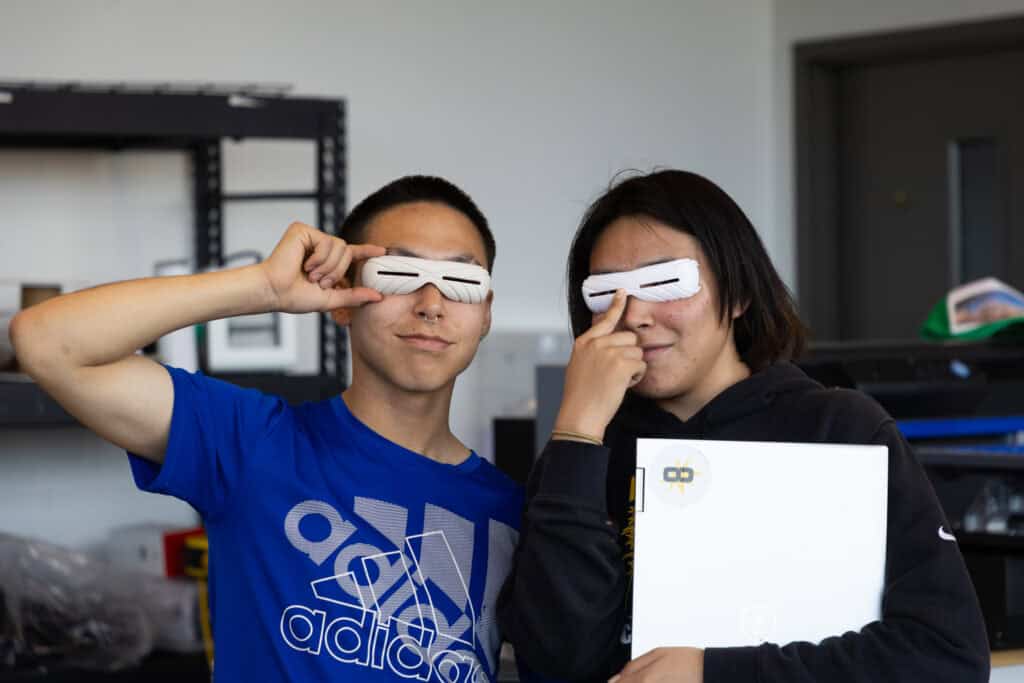
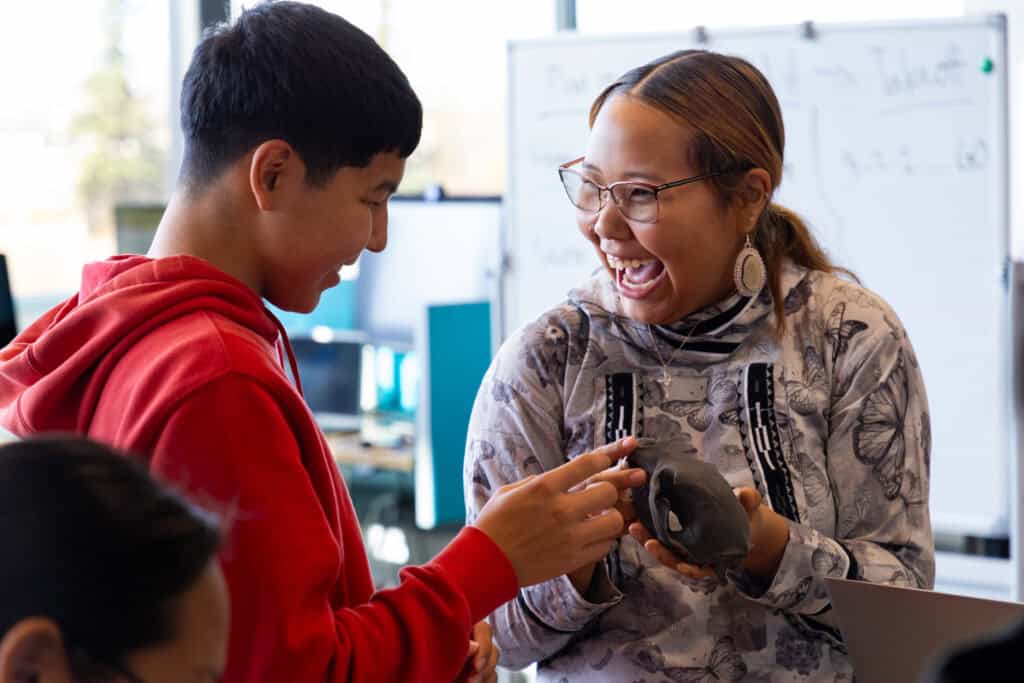
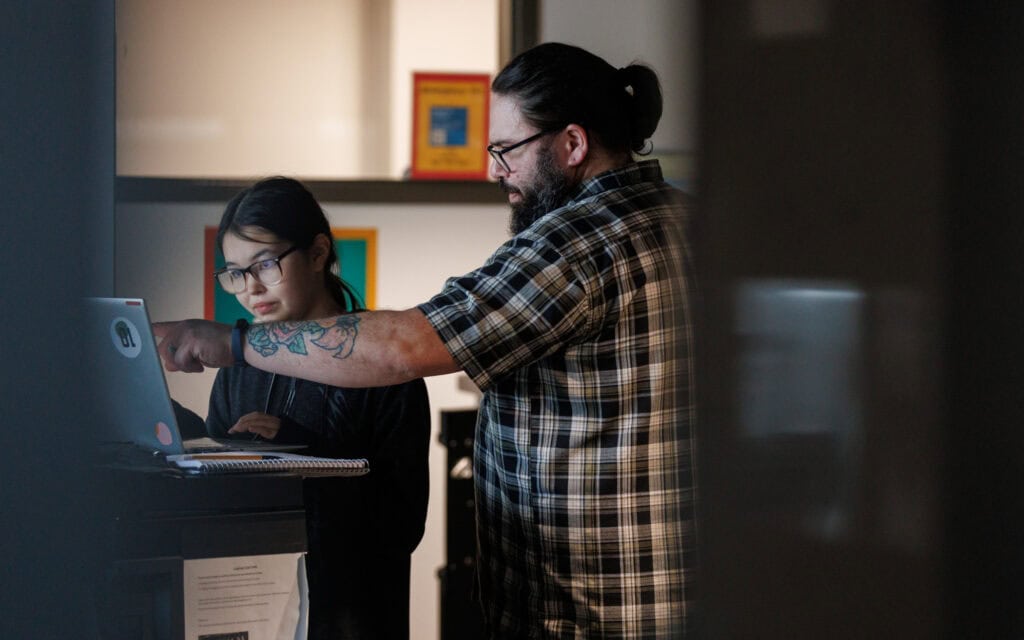
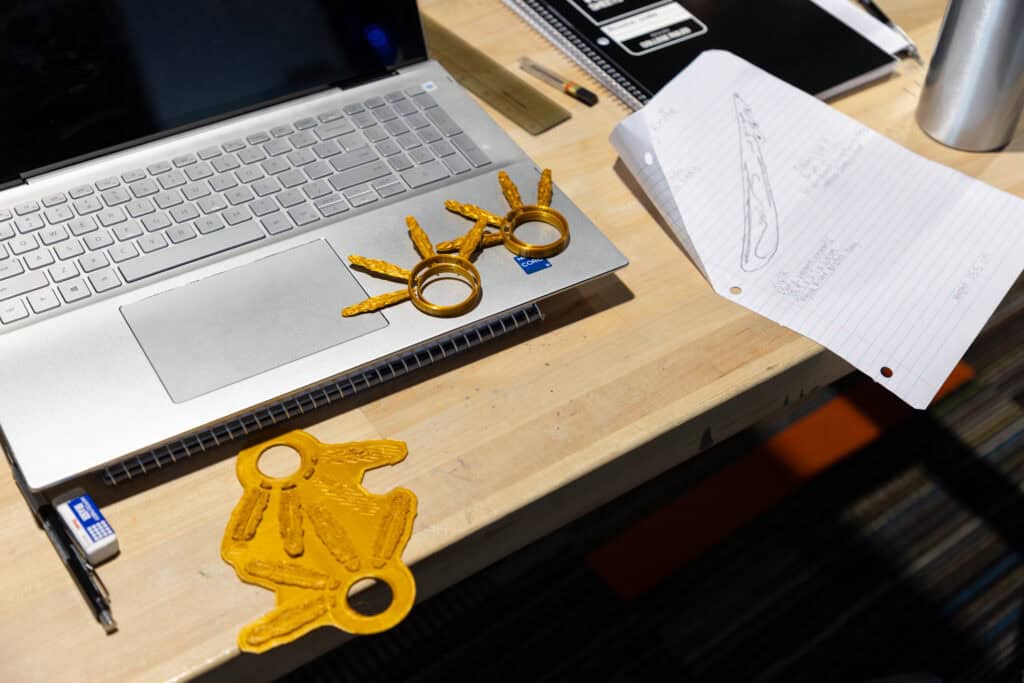
Every Friday this fall, the Denełchin Fab Lab came alive as high school students from the Lower Yukon School District filled the space. Laser cutters hummed, wood shavings drifted through the air, and 3D printers clicked away as teens shaped dance fans, printed story knives, sketched moccasin patterns, and brought high-tech iterations of their cultural designs to life. The space buzzed with energy as students moved between computers and carving benches, turning ancestral technologies into tangible creations using the Fab Lab’s state-of-the-art equipment.
Through a collaborative program between the Kusilvak Career Academy and Cook Inlet Tribal Council, 32 students from Western Alaska immersed themselves in this hands-on, culturally grounded STEM experience. Every Friday afternoon for 6 weeks, they spent two and a half hours learning measurement systems, drafting techniques, and digital design skills under the guidance of Fab Lab staff like Alla Handy and Benjamin Schleifman.
Exploring Culture Through STEM
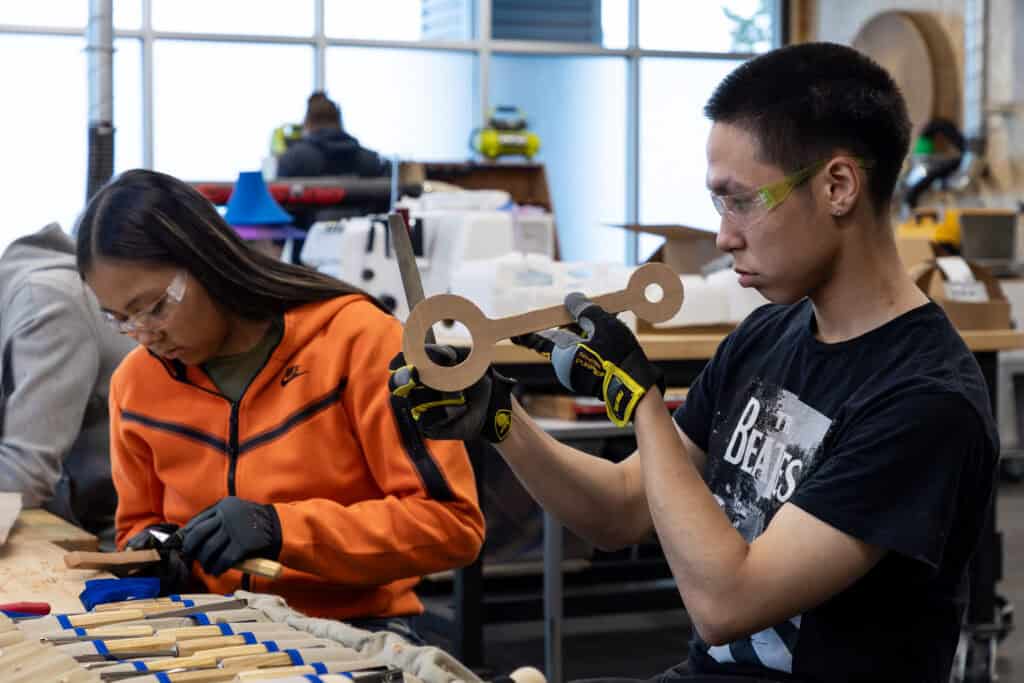
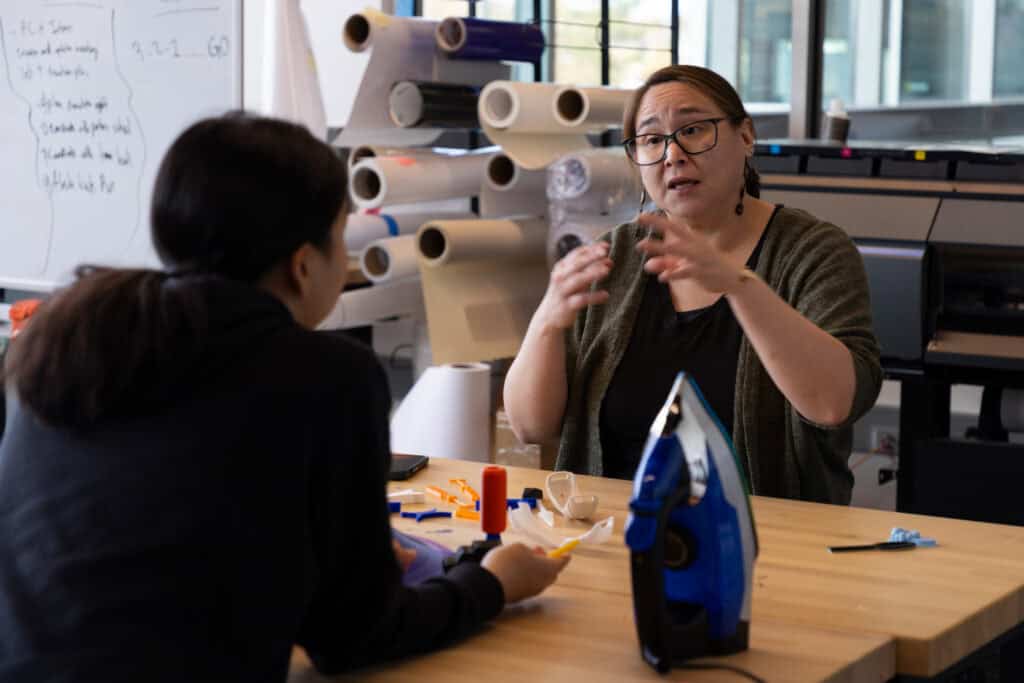
CITC’s Denełchin Fab Lab specializes in Indigenous-centered STEM curriculum for K–12 students across Alaska. Schleifman says that staff and students at the Fab Lab are guided by a foundational question: “What would our ancestors do with a facility like this?” Participating students learned a suite of news skills from Fab Lab instructors and conducted their own pointed research before transforming ideas into physical objects using 3D printers, Glowforges, CNC machines, and traditional carving and sanding tools.
Students’ projects drew directly from their cultural heritage—they designed atlatls (throwing boards), paddles, and iqmik pipes, exploring ancestral technology through modern fabrication. “We prompted them to deep dive into their own culture, their own lineage… that is integral to their growth as a student and as a whole human being,” says Schleifman. “All studies show that when our students are presented with a culturally responsive means to an end, they’re more receptive… they ultimately get more out of it.”
Building Culturally Responsive Education
The program was created when Kusilvak Career Academy reached out to explore whether CITC could help build a Career & Technical Education (CTE) opportunity for students visiting their Anchorage campus. CITC had been developing CTE concepts for years, so the timing was ideal. “We were really excited, so we jumped at the opportunity,” says Handy. The resulting pilot expanded on an earlier ANSEP project, Technical Drawing Through Culture, allowing Fab Lab instructors to build a richer curriculum around measurement, design, and cultural research.
Students began by comparing traditional Yup’ik and Iñupiaq body-based measurement systems with modern metric and empirical ones. Schleifman says that traditional measurement is inherently personal: “Each individual person has their own unique measurements… we were doing comparative measurements to empirical and metric.” This blending of cultural knowledge with technical precision set the stage for drafting, TinkerCAD design, and 3D modeling. Many students were encountering these tools for the first time.
Design, Iteration, and Hands-On Learning
From digital models, students moved to fabrication and refinement. They learned to prototype, troubleshoot, and revise their work. Some students struggled when early prints failed, but instructors used those moments intentionally. “What you build is usually not going to work out the first time,” Handy explains. “Those are teachable moments.”
Despite challenges—including a class size beyond the Fab Lab’s usual capacity—student engagement flourished. “Buy-in from our students was phenomenal,” Schleifman says. Many students didn’t want sessions to end, and many expressed a desire to visit the Fab Lab more than once a week.
A Lasting Impact on Identity
By the program’s end, nearly every student completed a culturally meaningful project and gained new confidence in design, problem-solving, and technology. Their physical design became tokens of the time spent in the Fab Lab, but what they built in identity, curiosity, and pride mattered even more. As Schleifman says, “Allowing them to form their own pedagogy using their own ancestral knowledge is more important than we can express.” Handy agrees. “They expressed time and time again how much they wanted to be here… having them engaged is a win for me,” she adds.